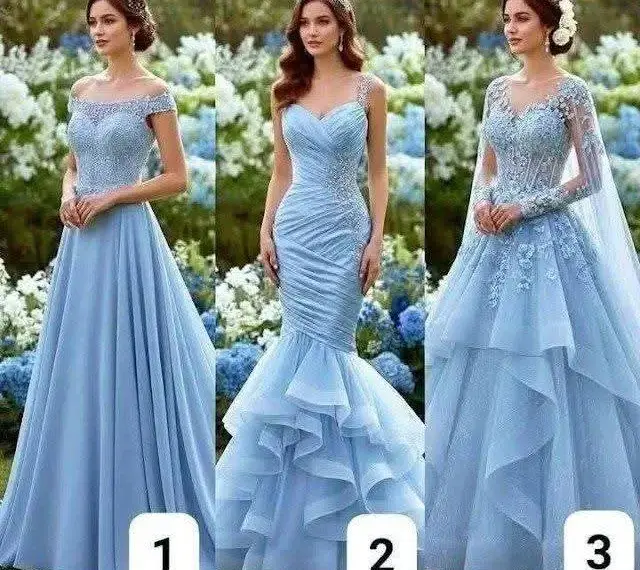
Sooner or later, every bride faces the same fascinating yet overwhelming question: which wedding dress is more beautiful? A sumptuous ball gown with layers of tulle? An elegant mermaid silhouette that accentuates every curve? A minimalist satin slip dress that exudes sophistication? Or a romantic lace gown worthy of a fairytale?
The truth is simple and deeply personal: the beauty of a wedding dress isn’t universal. It’s emotional, contextual, and uniquely tied to the woman who wears it. However, discovering what makes certain wedding dresses « more beautiful » can help brides make one of the most important fashion decisions of their lives.
Let’s take a closer look at the elements that define a bride’s beauty: from silhouette to fabric, from personality to cultural influences.
Beauty lies in the silhouette
When comparing wedding dresses, the first factor that determines which will look best is often the silhouette.
Ball gown: a fairy tale classic
The ball gown is the quintessential princess dress. Imagine a voluminous skirt, a fitted bodice, and a commanding stage presence. This silhouette evokes a timeless grandeur, reminiscent of iconic royal brides like Princess Diana, whose extravagant gown was synonymous with bridal opulence for an entire generation.
Why some people consider it more beautiful:
- Create a spectacular and unforgettable entrance.
- It adapts to different body types, highlighting the waist.
- I feel magical and ceremonial
However, others might find it excessive or too traditional. Beauty, once again, depends on your perspective.
Siren: The Dazzling Star
The mermaid silhouette hugs the body and flares out at the knee, accentuating curves and conveying a sense of confidence. Brides inspired by the glamour of the red carpet—think of modern celebrity weddings like Kim Kardashian—often choose this style.
Why some people consider it more beautiful:
- Enhances natural curves
- You feel bold, modern and confident
- Take beautiful photos from different angles
However, it can be less forgiving and sometimes less comfortable to wear for extended periods. For some brides, comfort is an integral part of beauty.
Line A: The all-time favorite
The A-line dress gently flares out at the waist, offering balance and elegance without being excessively bulky.
Why many consider her « the most beautiful »:
- Suitable for almost all body types
- Suitable for almost any location
- Elegant without exaggeration
The trapeze silhouette fascinates with its harmony, and harmony is often understood as beauty.
Sheath dresses and petticoats: minimalist style
Minimalist wedding fashion has gained popularity in recent years. Imagine clean lines, luxurious satin, and understated elegance—a style embraced by brides like Meghan Markle for her wedding to Prince Harry.
Why minimalists find it more beautiful:
- Timeless and sophisticated
- The focus is on craftsmanship, not decoration.
- It conveys a calm confidence.
Minimalist dresses prove that beauty doesn’t require excess.
Fabric: the language of weave
Sometimes two dresses have the same cut, but one looks better. Why? The fabric.
Lace: the embodiment of romance
Lace symbolizes tradition, femininity, and refined craftsmanship. It evokes an old-world charm and regal elegance. Brides dreaming of garden ceremonies or cathedral weddings often choose lace.
Beauty Factor:
- Intricate details add visual interest
- Create softness in photos
- I feel deeply like a bride
Satin and silk: luxurious simplicity
Smooth, textured, and luminous: satin and silk lend a subtle elegance.
Beauty Factor:
- It reflects light beautifully
- Offers a sculpted and sophisticated look
- A timeless classic that spans generations.
Tulle and organza: ethereal lightness
For brides who dream of an ethereal and light effect, these flowing fabrics will create magic.
Beauty Factor:
- Create movement
- Adds volume without weighing it down
- It conveys a sense of fantasy and romance.
Often, what looks best in photos isn’t necessarily as comfortable to wear, and vice versa.
The power of personal style
The most beautiful wedding dress rarely follows trends. It’s a matter of consistency.
A bride who usually wears bold, modern dresses might not feel comfortable in a traditional lace ball gown. A romantic soul might feel out of place in an elegant slip dress.
When a bride feels like herself – exhilarated, radiant, and confident – then the dress becomes wonderful.
Trust turns fabric into magic.
The role of place
A dress that looks great in a cathedral might not be appropriate for the beach.
- Beach wedding: flowing chiffon, soft silhouettes
- Ballroom Wedding: Dresses Made to Measure for Your Figure and Size
- Garden Ceremony: Lace, Floral Appliques, Delicate Movement
- Town hall wedding: chic minimalism
The environment can enhance or weaken the influence of a dress. Beauty flourishes in harmony with its surroundings.
Cultural and family influences
In many cultures, the wedding dress has a profound symbolic meaning. For example, at Indian weddings, red lehengas are traditionally worn, symbolizing prosperity and marriage. In Western weddings, white symbolizes purity and a new beginning.
Family traditions can also influence the perception of beauty:
- I’m wearing the lace from the souvenir collection.
- Turning back the mother’s veil
- Respect for cultural dress codes
Sometimes a dress seems more beautiful for what it represents, not just for how it looks
Trends versus timelessness
Wedding trends are constantly evolving.
In the 1980s, bridal fashion was dominated by bold sleeves and oversized bows—think Princess Diana.
In the 2010s, fitted lace dresses and illusion necklines became popular.
Now we see square necklines, sheer satin, detachable sleeves, and a minimalist aesthetic.
So, what’s more beautiful: the latest trend or the timeless?
Fashionable clothes can look fresh and trendy. Timeless clothes can look more elegant in photos.
The real question is: do you want your dress to reflect the moment or transcend it?
Emotional test
Here’s a secret often shared by wedding planners:
The most beautiful wedding dress is the one that evokes emotions in the bride.
Many brides describe the moment they begin a relationship with their “soulmate” and suddenly feel different: teary-eyed, radiant, confident.
Maybe it’s not the most expensive.
Maybe it’s not the most complicated.
Maybe it’s not what they imagined.
But apparently that’s the case.
And this emotional certainty takes precedence over comparison.
Beauty in the mirror versus beauty in photos
A practical but important note: some dresses are gorgeous in person, but look different in photos. Others, however, are gorgeous in photos, but less impressive in person.
Today’s brides must take into consideration:
- Interior lighting
- Outdoor sunlight
- Professional photographs
- Sharing on social media
Sometimes « more beautiful » means « more photogenic. » Other times, it means « more breathtaking in person. »
Both perspectives are important.
Comfort is an underrated beauty
A bride who can move, dance, sit, hug, and breathe freely radiates joy.
A dress that requires constant alterations, is tight, or causes discomfort can undermine self-confidence.
Comfort improves posture.
Posture improves appearance.
Appearance enhances beauty.
Never underestimate the power of comfort.
The psychology of comparison
When a bride tries on different dresses, comparisons become inevitable.
Dress A might have the perfect neckline.
Dress B might have gorgeous lace.
Dress C might accentuate your waist incredibly.
The mind often strives for perfection, but perfection is subjective.
Instead of asking “Which dress is prettier?”, try asking:
- Which dress makes me look taller?
- Which dress is best for me?
- Which dress do I not want to take off?
When two dresses are equally beautiful
This happens more often than you might imagine.
In that case, practical solutions to resolve tie cases may be useful:
- Balance sheet
- Comfort
- Flexibility to change
- Versatility (ceremony vs. reception)
Some brides even choose two dresses: one for the ceremony and one for dancing.
There is no rule that dictates choosing just one definition of beauty.
Truth: It’s the bride who makes the dress beautiful
Here’s the most important perspective:
A wedding dress doesn’t create beauty. It frames it.
A bride in love, surrounded by profound meanings, who is preparing to begin a new chapter in her life: this radiance cannot be achieved with lace and satin alone.
The light that shines on your wedding day comes from:
- Expectation
- I commit
- Celebration
- Emotion
The dress highlights this brightness.
So… Which wedding dress is the most beautiful?
A ball gown?
A mermaid?
A minimalist slip?
A romantic, vaporous dream?
The answer is: the one that makes the bride feel beautiful.
Beauty isn’t volume, shine, or fashion. It’s harmony: between personality, environment, emotions, and self-esteem.
The most beautiful wedding dress is the one that:
- I feel authentic
- It perfectly matches the spirit of the bride.
- It’s suitable for the occasion
- Create joy
And when the bride smiles at her reflection – not because the dress is impressive, but because she feels special – then the question disappears.
Because beauty is not measured by comparison.
It’s about connection.