Michael Jackson’s Daughter Paris Jackson Opens Up About Her Father: “My Dad Used To…” — What She Really Revealed
A recent wave of social-media posts featuring Paris Jackson has attracted attention with a dramatic headline suggesting that Michael Jackson’s daughter has finally “broken her silence” about what her father “used to” do.
The headline is designed to make readers expect a shocking revelation. But the reality is considerably more nuanced—and, in many ways, more touching.
Paris Jackson has actually been speaking about her father in several interviews during 2026, although she has repeatedly emphasized that her relationship with Michael Jackson is deeply personal. In August, she gave one of her most detailed accounts yet of what childhood was like inside the Jackson family, including the rules her father established around school, television, entertainment and his famous Neverland property. JJust Jared+1
And on August 29, 2026, Paris released new music connected to her relationship with her father, incorporating a private recording of Michael speaking to her when she was young. TThe US Sun
So what did Paris actually say?
The answer reveals a surprisingly disciplined side of her childhood—and a daughter who is still trying to separate her private memories of her father from the enormous public mythology surrounding Michael Jackson.
Paris Jackson’s Childhood Was Far More Structured Than Many People Realized
For decades, the public has imagined Neverland as a place where Michael Jackson’s children could spend their days surrounded by amusement-park rides, animals, movies and entertainment.
Paris’s recent account paints a different picture.
Speaking on Call Her Daddy in August 2026, she explained that she did spend the earliest years of her life at Neverland, but she rejected the idea that she simply grew up there without rules or responsibilities.
She described a childhood centered around education, chores and earning privileges.
Paris said she and her siblings were homeschooled by tutors. Their days included lessons in a dedicated classroom, and entertainment was something they received after completing their responsibilities. JJust Jared
The distinction is important.
Rather than being told that everything at Neverland was automatically theirs, Paris recalled being taught that the attractions were not possessions for the Jackson children to take for granted.
According to her account, amusement-park rides, animals and movies were treated as rewards for good behavior, completing schoolwork and doing chores. TThe Times of India+1
That description provides a very different picture from the fantasy many outsiders associated with Neverland.
“That Did Not Belong to Us”
One of the most widely reported parts of Paris’s interview concerned Neverland’s amusement attractions.
The property famously contained rides, a movie theater, animals and other attractions. Yet Paris explained that her father deliberately taught his children that these things were not simply theirs because they lived there.
She recalled being told that the attractions were intended for children who were less fortunate, including children dealing with serious illnesses who might not otherwise have the opportunity to visit places such as Disneyland. TThe Times of India
That lesson appears to have stayed with her.
The underlying message was simple: having access to something does not necessarily mean you own it or are entitled to it.
Paris’s recollection suggests that Michael attempted to instill a sense of gratitude and responsibility in his children despite the extraordinary wealth and fame surrounding their family.
That may be one reason another theme has repeatedly emerged when Paris discusses her father: work.
Michael Jackson Wanted His Children to Earn Their Rewards
Paris has previously spoken about the unusual circumstances of being raised by one of the most famous entertainers in the world.
It would have been easy for the children of a global superstar to grow up believing that money could solve every problem.
According to Paris, her father tried to prevent exactly that attitude.
Her recent interview described a consistent system in which schoolwork, chores and good behavior came first, while entertainment came afterward. JJust Jared
The same principle apparently followed the children even when they were away from Neverland.
Paris explained that the family moved frequently, and the reward system continued wherever they happened to be living.
If they were staying somewhere else, a trip to a local attraction could become the weekend reward.
The location changed, but the principle remained.
Do your responsibilities first. Enjoy yourself afterward.
For Paris, this seems to have become part of the way she remembers her father’s parenting.
Television Was Also Restricted
Another surprising revelation involved television and movies.
Paris said that television was not freely available to the children whenever they wanted it.
There were exceptions, including weekends and situations in which they were studying filmmaking. TThe Times of India+1
That might sound unusual today, especially for children growing up in a household surrounded by entertainment.
But Michael Jackson was an extraordinarily visual artist. Film, music videos, choreography and performance were central to his professional life.
Paris’s recollection therefore suggests that entertainment was sometimes approached as something to study rather than simply consume.
For example, she described circumstances in which films could be watched as part of learning about filmmaking.
That detail is particularly interesting because Paris eventually pursued her own career in music and entertainment.
Paris Has Also Been Rethinking How She Talks About Her Father
The Neverland revelations are only part of Paris Jackson’s recent conversations about Michael.
In May 2026, she appeared on Jack Osbourne’s Trying Not to Die podcast and discussed something more personal: why she no longer feels obligated to publicly demonstrate her love for her father. EE! Online+1
For years, Paris was expected to participate in public remembrance of Michael.
Fans watched her social-media accounts around birthdays, Father’s Day and anniversaries connected with his death.
When she did not post something, some people interpreted her silence.
That expectation eventually became uncomfortable for her.
Paris explained that she had once felt as though she owed the public access to her private relationship with her father. She now sees the situation differently.
Her relationship with Michael, she said, is personal.
And that means she does not have to constantly prove it to strangers.
The Difference Between Being His Daughter and Being His Fan
This is perhaps the most important point in understanding Paris’s recent comments.
Millions of people around the world knew Michael Jackson as an entertainer.
Paris knew him as her father.
Those are fundamentally different relationships.
A fan may celebrate an artist’s birthday, listen to their music and discuss their legacy.
A daughter remembers the person who helped raise her.
Those memories can include ordinary experiences that the public never sees.
Paris has increasingly pushed back against the idea that she needs to behave like a fan in order to demonstrate that she loved her father.
She has described herself as being in a peaceful and beautiful place regarding her relationship with Michael and has emphasized that she does not need to make that relationship public. PPeople.com+1
That perspective helps explain why sensational headlines about her “breaking her silence” can be misleading.
Paris has not been silent.
She has simply become more selective about what she shares.
A Daughter’s Memories Are Different From the Public’s Memories
Michael Jackson’s life has been analyzed from almost every possible angle.
His music has been studied.
His performances have been replayed.
His clothing, dance moves, business decisions and personal life have been examined endlessly.
But Paris’s memories belong to a different category.
She remembers the father who was there when she was a child.
That distinction became especially important after his death in 2009, when Paris was only 11 years old.
At that age, she was suddenly grieving while the entire world was watching.
Her father’s death was simultaneously a private family tragedy and an enormous international news event.
That is an extraordinarily difficult situation for any child.
The 2009 Memorial Remains One of Paris’s Most Emotional Public Moments
One of the most unforgettable moments in Paris Jackson’s childhood came at Michael’s memorial service in July 2009.
She had not originally planned to deliver a speech.
During her 2026 Call Her Daddy appearance, Paris explained that she ended up speaking because family members were asked whether one of the children would say something, and eventually she stepped forward. YYahoo News Malaysia
She was just 11.
In front of millions of viewers, Paris became visibly emotional while speaking about her father.
The moment has remained one of the most widely remembered images of Michael Jackson’s funeral.
But with the perspective of adulthood, Paris now appears increasingly interested in reclaiming the difference between that public moment and the private relationship that existed behind it.
Paris Recently Shared Another Private Connection With Her Father
The timing of Paris’s latest musical release has made her comments even more emotional.
On August 29, 2026—Michael Jackson’s 68th birthday—Paris released a double single that included a song called “The Breeze.”
The recording includes what has been reported as a private recording of Michael’s voice speaking affectionately to his daughter. A young Paris can also be heard responding. TThe US Sun
The significance isn’t simply that Michael’s voice appears on the recording.
It’s that the recording captures something intimate between a father and daughter.
There is no stadium.
No concert.
No music-video spectacle.
No performance for millions of people.
Just a private family moment preserved in audio.
That makes the recording particularly powerful.
Paris Says the Music Isn’t About Proving Anything
Interestingly, Paris herself has resisted describing the new music as a conventional tribute.
She characterized the project as a personal artistic expression about love, loss and the difference between private relationships and relationships that exist primarily through public attention. TThe US Sun
That idea connects directly with what she said months earlier on Jack Osbourne’s podcast.
She does not want her relationship with Michael to become a performance.
She doesn’t need to post something every year to prove that she misses him.
She doesn’t need to reproduce the language of millions of fans.
And she doesn’t need to explain every memory.
Instead, she can put those feelings into music.
Why the Viral “My Dad Used To…” Headline Needs Context
The headline circulating online—suggesting that Paris Jackson has suddenly revealed something shocking beginning with “My dad used to…”—takes a genuine recent interview topic and packages it as a mystery.
There is a real story behind the headline.
Paris did discuss what her father “used to” tell her and her brothers.
But the central revelation was not a sensational confession.
It was about rules, discipline and boundaries during childhood.
She described Michael teaching his children that the attractions at Neverland were not simply theirs to use whenever they wanted. Entertainment was generally connected to good behavior, schoolwork and chores. TThe Times of India
That is interesting because it challenges one of the most obvious assumptions about growing up in Michael Jackson’s world.
The reality, according to his daughter, was not unlimited entertainment.
It was structured.
The Human Side of Michael Jackson’s Parenting
It is impossible to understand Paris’s memories without acknowledging the unusual environment in which she grew up.
Her father was not an ordinary parent.
He was one of the most recognizable entertainers in modern history.
Every family outing could attract photographers.
Every childhood photograph could become a magazine cover.
Even seemingly normal experiences had the potential to become international news.
That helps explain some of the unusual parenting choices Paris has described.
The children were sometimes photographed wearing coverings over their faces in public, something that Michael said was intended to protect their identities and allow them some measure of privacy.
Paris has also spoken about how strange it was to gradually realize just how famous her father actually was.
As a child, your father is simply your father.
The world may see a superstar.
You see the person who tells you to finish your homework.
That contrast is central to Paris’s story.
Paris Is Now Telling Her Own Story
At 28, Paris Jackson is no longer simply “Michael Jackson’s daughter.”
She is a musician, performer and songwriter with her own creative identity.
That does not mean Michael is irrelevant to her life.
Quite the opposite.
Her recent music and interviews demonstrate how deeply her relationship with him continues to influence her.
But she is increasingly defining that relationship on her own terms.
That’s an important distinction.
Instead of allowing the public to decide what a daughter of Michael Jackson should say, Paris is choosing what she wants to remember and how she wants to express it.
Sometimes that means an interview.
Sometimes it means a song.
Sometimes it means sharing an old photograph.
And sometimes it means saying nothing at all.
What Paris’s Story Says About Growing Up Famous
There is a broader lesson in Paris Jackson’s experience.
Children of celebrities often inherit a strange contradiction.
They can receive enormous privilege while simultaneously losing some of the privacy ordinary children take for granted.
Their parents may be household names.
Their childhood photographs may become valuable commodities.
Their mistakes can become headlines.
And when a famous parent dies, the child’s grief can become public property in the eyes of strangers.
Paris has spent much of her adult life navigating exactly that tension.
Her recent comments suggest that she is finally becoming comfortable with drawing a line between her public identity and her private memories.
That may be one of the most significant developments in her story.
A More Complicated Picture of Neverland
Neverland has become one of the most heavily discussed locations associated with Michael Jackson.
For some people, the name immediately evokes music history and childhood fantasy.
For others, it evokes the controversies and allegations that surrounded Jackson’s life.
Paris’s recent comments don’t erase any of those broader historical debates.
They provide something different: a child’s recollection of what it was like to live within the environment.
Her account emphasizes school.
It emphasizes rules.
It emphasizes earning rewards.
And it emphasizes the idea that the attractions were intended for children who needed them—not simply for Michael’s own family.
Those details don’t answer every question about Neverland, nor should they be treated as doing so.
But they do provide another piece of the complicated story.
Paris’s Relationship With Her Father Remains Deeply Personal
Perhaps the most striking theme running through Paris Jackson’s recent interviews is not a particular revelation.
It is privacy.
She has made it clear that she loved her father.
She has spoken about missing him.
She has discussed her childhood.
She has talked about the memorial service.
And now she has incorporated his voice into her music.
But she does not believe she owes the public every memory she possesses.
That is understandable.
A celebrity may belong to public culture.
A family relationship does not.
For Paris, Michael Jackson was not primarily “the King of Pop.”
He was Dad.
And the difference matters.
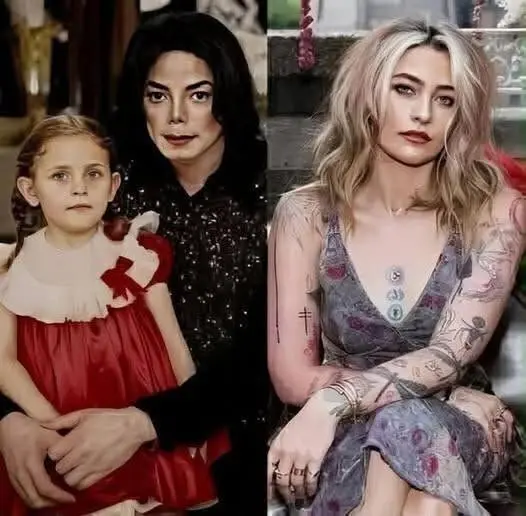
The Image Going Viral Tells Only Part of the Story
The photograph accompanying many social-media versions of this story reinforces the emotional angle.
It shows Paris as a child alongside her father and invites viewers to compare that image with the adult Paris they see today.
But photographs can never tell the whole story.
They capture a moment.
Paris’s recent interviews provide something photographs cannot: her own interpretation of her childhood.
She remembers a father who imposed rules.
A father who emphasized school and chores.
A father who limited television.
A father who taught his children that privilege should not automatically mean entitlement.
And, above all, a father with whom she shared a relationship that she now wants to keep partly for herself.
The Real Takeaway
So, did Paris Jackson “break her silence”?
Not exactly.
She has been speaking about her father for years.
What has changed is how much control she exercises over the conversation.
In 2026, Paris has offered some unusually detailed memories of her childhood with Michael Jackson, particularly in her August appearance on Call Her Daddy. She discussed Neverland, homeschooling, discipline, entertainment and her relationship with her parents. JJust Jared
She has also talked about why she no longer feels compelled to publicly demonstrate her relationship with her father. EEW.com+1
And now she has transformed a private father-daughter memory into music, allowing listeners to hear a brief exchange between Michael and his young daughter. TThe US Sun
Taken together, those moments tell a much more meaningful story than a sensational clickbait headline.
They show a woman looking back at a complicated childhood, remembering the ordinary father behind an extraordinary public figure, and deciding for herself which parts of that relationship she wants the world to see.
Perhaps the most important part of Paris Jackson’s recent revelations is therefore not what Michael Jackson “used to” say.
It is what Paris is saying now:
Her memories belong to her.
And after spending much of her life growing up under the world’s microscope, she is finally deciding how much of that private world she wants to share.
Note: The viral headline “My dad used to…” is incomplete and can give the impression of a more sensational revelation than the available reporting supports. The verified recent comments concern Paris’s childhood rules at Neverland, her father’s approach to discipline and her increasingly private relationship with him.