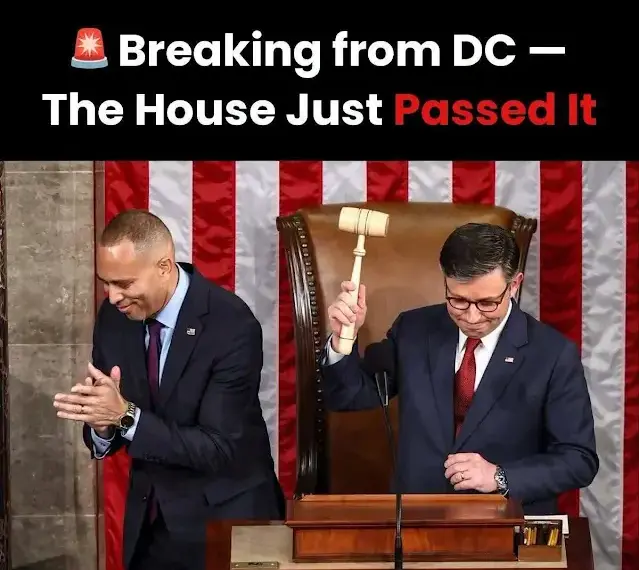
The House Just Voted to End the Iran War — What the Vote Really Means
A dramatic headline began circulating online claiming that the House had voted to “end” the Iran war. The wording is attention-grabbing, but the reality behind the vote is more complicated—and understanding that distinction matters.
On June 3, 2026, the U.S. House of Representatives voted 215–208 to approve a war-powers resolution directing President Donald Trump to remove U.S. armed forces from hostilities with Iran unless Congress formally declares war or authorizes military force. Four Republicans joined Democrats in supporting the measure.
The vote represented an important challenge to the administration’s approach to the conflict, but it did not automatically bring the war to an immediate end. The measure still faced significant procedural and political obstacles, including questions about Senate action and the practical ability of Congress to enforce the resolution.
A Vote That Sent a Powerful Message
The House vote was significant because Congress had repeatedly struggled to advance similar efforts.
For months, lawmakers had debated whether the president had sufficient congressional authorization to conduct military operations against Iran. Democrats argued that the Constitution gives Congress an important role in decisions involving war, while some Republicans increasingly expressed concern about the duration, cost and consequences of the conflict.
The final House vote marked the first time during the conflict that a war-powers measure successfully passed the chamber.
The four Republicans who crossed party lines were Thomas Massie of Kentucky, Brian Fitzpatrick of Pennsylvania, Tom Barrett of Michigan and Warren Davidson of Ohio. Every voting House Democrat supported the resolution.
That bipartisan element made the result particularly noteworthy.
It demonstrated that disagreement over the war was no longer confined to one political party.
What Exactly Did the House Vote On?
Despite the dramatic language used in some social-media posts, the House did not simply pass a law declaring, “The war is over.”
Instead, lawmakers approved a war powers resolution directing the president to remove American forces from hostilities with Iran unless Congress provides authorization for military action.
That distinction is crucial.
The War Powers Resolution of 1973 was designed to place limits on the president’s ability to keep American forces engaged in hostilities without congressional authorization. Under the law, presidents generally face a 60-day limit for unauthorized military involvement, with additional provisions concerning the safe withdrawal of forces.
The administration, however, disputed how the clock applied to the Iran conflict.
The Trump administration argued that a ceasefire had effectively terminated hostilities and therefore affected the calculation. Critics in Congress disputed that interpretation, particularly because military activity and tensions had continued.
That disagreement became one of the central legal and political issues surrounding the vote.
Why Were Republicans Breaking Ranks?
Perhaps the most interesting aspect of the vote was not simply that Democrats supported it. Democrats had been pushing for restrictions on the president’s war powers for months.
The bigger story was that several Republicans were willing to join them.
Some Republican lawmakers had become increasingly concerned about the economic and political consequences of a prolonged conflict. Rising energy prices, uncertainty in international markets and questions about America’s long-term objectives all contributed to the debate.
Representative Thomas Massie, one of the most outspoken Republican critics, argued that Americans were tired of the consequences associated with the conflict.
Other lawmakers were focused more directly on constitutional questions.
Their argument was relatively straightforward: if the United States was going to remain involved in a major military conflict, Congress should have a meaningful role in authorizing that action.
This is one of the oldest tensions in American government—the balance between presidential authority and congressional power.
Democrats Called the Vote a Constitutional Responsibility
Democratic lawmakers celebrated the outcome as evidence that Congress was beginning to reassert its authority over military policy.
Representative Gregory Meeks, who introduced the resolution, argued that Congress had a constitutional responsibility to exercise oversight when the executive branch conducts military operations.
From that perspective, the vote was bigger than the Iran conflict itself.
It was about the separation of powers.
The Constitution divides governmental authority among different branches, and Congress has traditionally possessed powers related to declaring war and funding military operations.
Supporters of the resolution therefore viewed the House action as an attempt to restore congressional influence over decisions that can have enormous consequences for American soldiers, taxpayers and civilians overseas.
Republicans Who Opposed the Resolution Saw It Differently
Not everyone considered the vote a constitutional victory.
Critics argued that congressional action could undermine the president’s negotiating position.
House Foreign Affairs Committee Chairman Brian Mast described the vote as political maneuvering and argued that restricting the president during negotiations could weaken America’s leverage.
Secretary of State Marco Rubio similarly warned that Iranian negotiators could interpret congressional restrictions as evidence that the administration’s ability to respond militarily was being limited.
That creates a difficult strategic question.
If a president is negotiating with another country while Congress simultaneously attempts to restrict military options, does that strengthen diplomacy—or weaken it?
Supporters and opponents of the resolution answered that question very differently.
The Vote Was Not the Same as Ending the War
This is perhaps the most important point for anyone who encountered the headline online.
The House vote did not mean that American military operations automatically stopped that day.
The resolution still faced further hurdles.
The Senate had previously advanced a similar measure through a procedural vote, but final congressional action remained uncertain.
There were also questions about the legal force of the House resolution and the different procedures surrounding concurrent war-powers resolutions.
Reuters described the House vote as largely symbolic because additional congressional action would be necessary before it could produce the practical consequences suggested by the headline.
That does not make the vote meaningless.
A symbolic congressional vote can still be politically powerful.
It can demonstrate that support for a policy is weakening. It can influence negotiations. It can change public discussion. And it can make future votes easier for lawmakers who were previously reluctant to break with their party.
Why the 215–208 Vote Matters
The margin itself tells an important story.
A vote of 215–208 is extremely close.
The resolution succeeded because four Republicans joined Democrats. Without those Republican votes, the outcome would have been dramatically different.
Those four votes demonstrated that the administration could not necessarily assume unanimous Republican support on the Iran question.
That matters politically.
Presidents generally have greater influence over foreign policy when their own party remains united behind them. When members of the president’s party begin voting against the administration on major national-security questions, it can signal growing concern within the governing coalition.
It does not necessarily mean that the entire party has turned against the president.
But it does mean that the issue has become more complicated.
A Conflict With Economic Consequences
The congressional debate also took place against a backdrop of concern about the economic consequences of the conflict.
Wars do not remain confined to battlefields.
Military confrontations involving major energy-producing regions can affect oil prices, transportation costs, food prices, manufacturing and global trade.
Lawmakers cited concerns about gasoline, diesel and other costs as part of the growing political pressure surrounding the conflict.
For ordinary Americans, foreign policy can therefore become a domestic economic issue.
A family may never see a battlefield, yet still feel the effects of a conflict when filling up a vehicle, paying a shipping bill or purchasing goods whose prices are influenced by energy and transportation costs.
This helped make the Iran war a politically sensitive issue heading toward the November midterm elections.
Trump Rejected the Significance of the Vote
President Trump responded angrily to the House action.
He criticized the vote as coming at a particularly sensitive moment in negotiations with Iran and accused lawmakers who supported the resolution of undermining the administration’s position. Reuters reported that Trump characterized the vote as unhelpful while negotiations were continuing.
From the administration’s perspective, military pressure could be an important bargaining tool.
If Iran believed the United States had fewer military options available, officials argued, Tehran might have less incentive to make concessions.
Opponents responded that continuing an open-ended conflict without clear congressional authorization created its own dangers.
The disagreement therefore wasn’t simply about whether war was good or bad.
It was also about how diplomacy works.
The Constitutional Question
At the center of the debate is a question that has appeared throughout American history:
Who has the final word when the United States goes to war?
The president is commander in chief, giving the executive branch enormous responsibility over military operations.
Congress, however, has constitutional authority over declarations of war and control of federal spending.
The War Powers Resolution was created in an attempt to clarify that relationship.
But presidents and members of Congress have repeatedly disagreed about its constitutionality and practical application.
The Iran conflict revived those arguments once again.
Supporters of the House resolution believe Congress should not simply be informed after military action begins.
Opponents argue that presidents need flexibility to respond rapidly to international threats, particularly when negotiations and military operations are closely connected.
Neither side sees the issue as merely procedural.
Both believe lives and national security could be affected.
Why the Headline Can Be Misleading
Social-media headlines often compress complicated legislative developments into a few dramatic words.
“The House Just Voted to End the Iran War” sounds like the conflict immediately stopped.
That is not what happened.
A more accurate description would be:
The House voted to direct the president to end U.S. participation in hostilities with Iran unless Congress provides authorization for military action.
That wording may be less dramatic, but it explains what lawmakers actually did.
Understanding this distinction is particularly important when political stories spread rapidly online.
A vote can be historic without being immediately effective.
A resolution can be politically powerful without automatically changing events on the ground.
And a congressional rebuke can matter even when the legal consequences remain uncertain.
What Happens Next?
The next stage depends heavily on Congress and the administration.
If the Senate advances a comparable measure, lawmakers could face another major confrontation over presidential war powers.
If Congress does not complete the process, the House vote could remain primarily a political statement.
Meanwhile, negotiations with Iran could change the entire situation independently of congressional action.
Diplomatic developments, ceasefires, military decisions and international pressure can all alter the trajectory of a conflict.
That is why the House vote should be viewed as one part of a much larger story.
A Turning Point, But Not an Ending
The most reasonable way to understand the vote is as a turning point rather than a definitive ending.
For the first time during this conflict, the House successfully passed a measure seeking to constrain the president’s ability to continue military operations without congressional authorization.
Four Republicans joined Democrats.
The final vote was 215–208.
The result exposed divisions within the Republican Party, highlighted longstanding constitutional questions and increased pressure on the administration to explain the objectives and legal basis of the conflict.
But it did not instantly bring American forces home.
It did not automatically establish peace.
And it did not settle the constitutional debate over presidential war powers.
Those questions remain much bigger than one vote.
Final Thoughts
The phrase “The House Just Voted to End the War” is powerful because it captures the emotional significance of the moment.
But the reality is more nuanced.
Lawmakers voted to invoke congressional war powers and direct the president toward ending U.S. participation in hostilities without congressional authorization. The vote demonstrated growing concern inside Congress and, importantly, showed that some Republicans were prepared to break with the White House on the issue.
Whether that pressure ultimately produces a lasting change depends on what happens next.
Congress still has to navigate its own procedures. The administration still controls major elements of foreign and military policy. Diplomats still have to negotiate. And the broader conflict remains dependent on developments far beyond the House chamber.
What the vote undeniably accomplished was to make one message unmistakable:
The debate over America’s involvement in the Iran conflict is no longer confined to the White House. Congress has entered the fight directly—and lawmakers are demanding a greater say over what happens next.